Friday, January 17, 2014

The ants come marching one by one, hoorah, hooray...

After the first fews days that Lucy and Phillipe were home from the hospital, utilities seem to have sorted themselves out. We've had only a couple more cuts of electricity and no loss of water, let alone—as we were having for a few days—simultaneous suspensions of both. When these interruptions occur, they just do. There are no question because there are no answers. You just wait and sooner (2 minutes) or later (2 days) service will return.

We have continued, though, to have problems with maintaining continuous Internet access. I'm very dependent on my laptop for my contact with the US; Yves uses his constantly for his professional studies about solar energy. Well, I'm sure everyone knows how disappointing it is to be blacked out.

I am not proud of the fact—but it's the truth—that when I can't get Internet service, I immediately think dark thoughts about the Third World and its inadequacies. Whatever he thinks, Yves calls the provider at once. And once, it actually proved to be a system-wide problem, solved a few hours later, and we were up and going again. Just like home, in fact.

Another time, Yves called the provider. The help desk could find nothing wrong, so we were left fulminating against the company—until Yves noticed that the cleaning lady had tugged the cord while cleaning, leaving it only partially plugged in. Another time, after we got indignant with the company, Yves discovered a bent wire at the back of the box that interrupted the connection. He straightened it: problem solved. (Whoops.)

Yesterday we learned a diagnostic of local and lasting usefulness. Once more on our screens appeared the tiresome message that we were not connected. Yves made yet another call. You know how the help people always ask you to unplug the router and plug it back into the jack? Yves complied. But once he unplugged it, he couldn't force it back because he had released not only the cord but pulled the plug on massive a swarm of ants—an army with spears and swords and frightening, ferocious expressions!—that burst into the living room.

The help desk agent told Yves, in French, of course, "I think we've found your problem, Sir."

Yves and Lucy lunged on the invaders and eventually beat them back, squirting the interior of the wiring channel with enough liquid Madar to satisfy a genocidal dictator. Now the computers work just fine. And we know to check for marauding ants before calling the company. Maybe the help desk will even think to add "nesting ants?" to their check list, up there with "plugged in?"

Thursday, January 16, 2014

Alfa

When you need a woodworker in Cite Assemble, you call Alfa.

One of my high priorities when I arrived and Lucy was still pregnant was that she have a sturdy, high-backed rocking chair for nursing. I had a fund of 85 euros (around $115) left from the Germany trip that I intended as the seed money for this gift. How you buy a rocking chair in Dakar, I had no idea. The Western furniture stores are fabulously expensive and needlessly stylish ("Lifestyle!") for the intended humble, domestic use. Maybe the alternative was the downtown market where you can find almost anything you want: bras, telephones, expresso makers, floor mats for your car. It's arranged as acres of vendors connected by narrow wooden walkways under make-shift roofing, true warrens of commerce and dens of pickpockets. Exciting, terrifying…How would we find a rocking chair there? How would we get one out? (Lucy's told me since that they don't deal in furniture there. What a relief.)

Yves was gracious about receiving my gift and Lucy was delighted: She could already imagine how good the back support and rocking would be. Shopping for it? They didn't hesitate for a moment: They called Alfa.

Alfa is a man who looks about 17 and lives in the neighborhood. I'm finding that almost every need can be met in the neighborhood. Alfa is the carpenter. He's made the beds in this apartment, to specifications given by Yves and Lucy. Likewise, he's made their armoires and bookcases. After the November infestation of bedbugs when Lucy was alone, 37 weeks pregnant, and Yves in Benin, it was Alfa to the rescue. He tossed the mattresses for her, and likewise some furniture made of porous woods. He treated every other wooden thing with sealant, fumigated the apartment, and had new mattresses cut from thick foam. What a hero.

So, on the day the topic of the chair came up, Alfa appeared. Lucy and Yves had trolled the Internet for  pictures of rocking chairs and had chosen a model that Alfa took notes on. Although it didn't appear until several days after Phillipe's birth, the chair finally arrived unannounced, beautiful and sturdy.

Just one problem with it: Lucy had to use a stool because it was so tall that her feet couldn't touch the floor.

The problematic height was pointed out to Alfa through a telephone call. I wondered, when he didn't come, if they might try him again. I was frustrated, but Lucy assured me, that's the way business gets done: C'est la vie. All in good time; he'd get to it and reminders weren't necessary.

Finally, three days ago (on John's 2-week birthday) Alfa appeared, remeasured, took the chair away and brought it back only a day later. It's perfect, just what I wanted for my girl and new mother. I'm told that the whole project cost $80.

We gave Alfa a new commission when he returned the revised chair. Again, I was thinking we'd need to find some Western frame shop, but it never entered the collective mind of Yves and Lucy,  for whom it was obviously a job for Alfa.

Over the week past I've made a series of alphabet drawings to decorate the baby's room, one sheet for each of his many, many names. Yves showed him the project; they had a very long parlay (out of hearing of Lucy and me) about specifications, including whether he knows a glazier who could cut glass adequately. They bartered for the price for the set of five and reached an agreement. Alfa wanted to take the drawings with him but Yves declined to let them go, assuring him that he trusts that the work will be fine, but keeping to himself his fear that the drawings would come back enhanced with carpenter's glue.

So now we're excited to see the framed drawings. But the one thing on which there's been no agreement—and I know not to expect one—is a completion date.

Wednesday, January 15, 2014

Sleep and Identity

Like Madar, one mother is good for every
problem. One size fits all.
Never one to turn down an opportunity for some shut-eye, I've become a marathon sleeper in Dakar. I no longer sleep twelve hour nights—it took me a while to drift out of jet lag. Now I just sleep very deeply for nine or ten hour every night and pull myself out of bed because I know the morning's complicated routines can't wait forever. Lucy and Yves have the baby to attend to, so for me, there's oatmeal and coffee to make, water to start heating for the several baths. I do what dishes are in the sink. And I attend to baby laundry early enough that it will line-dry during the day. In short, there's too much to allow lying about in good conscience.
But I don't apologize about my extended nights. I fall asleep instantly and profoundly. I'm exhausted by the end of day. Is it because of the Little Orphan Annie routines, the scrubbing and hearth-tending? Hardly: I think it's more related to little Phillipe's work than to any adult work I'm doing. It's trying to figure out who I am and where I am. Formation of identity is a monumental task.
This is my first time as a grandmother. There's no doubt that it is a surprise to my sense of time—chronological time has oddly dissipated. I'm just in the flow, as if I'd been in a pirogue on the indefinite sea of time forever. I find, too, the being thrust into the grandmother role has evoked instincts and emotions I'm surprised to find recurring fully formed after over 25 years. Again, my sense of chronological time has been twisted, like the receiving blankets I wring out for the line.
Before this trip, I'd met Yves only once, the week of his wedding to Lucy. A man's wedding week is not the time to get to know him. Now we speak on Skype, and Lucy sounds happy in the extreme. But I spent some time at his parents' house in St. Louis during wedding week, and so I have some idea of the mores and the family he grew up with. His parents—wonderful people—have cultural practices and attitudes very different than the ones Lucy knew. How, I've worried, would Yves feel about his mother in law's extended visit? I'm a very different sort of woman—and his own mother had six children, after all!
Some of my readers may remember the great blues song that was part of my childhood, the Ernie K-Doe hit, Mother in Law . The lyrics express the stereotypical American man's attitude toward his wife's interfering mother, who refuses to yield ascendency over her daughter to the husband: 
The worst person I know...
Add caption
A she worries me, so                  Satan is her name:
If she'd leave us alone
A we would have a happy home
Sent from down below

Mother in law, mother in law

Satan should be her name
To me they're bout the same
Every time I open my mouth
She steps in, tries to put me out...
 
She thinks her advice is a contribution
But if she would leave that would be the solution
And don't come back no more 
I am haunted by those lyrics! In my heart of hearts, I know that I have to win Yves away from the horror of that primal assessment. My greatest terror is that I will place a wedge between husband and wife during so crucial a time in their marriage; that my presence will mean less time for him and his baby; that Yves will come to resent me and make it difficult for me ever to come back; that I won't give him enough to eat…Oh No!!
Well, none of this seems to be occurring. He is, though, a man of few words, with great respect for elders, who is very concerned that I not do too much work. According to Yves, I am here on vacation. Much that I don't think twice about doing—going to buy 10 liters of water at the boutique; carrying the tub of laundry water into the house to the toilet to dump it—Lucy has asked me to stop doing. I should ask Yves because those are his jobs. It's not a question of ability, but of gender and family rank.

It is also customary for him not to express emotion around me, to be formal and polite. We have got to the place where we do joke some and it is incontrovertible that we like each other; but every time we meet, it feels to me like a new beginning. Living in the same house, encountering each other in multiples circumstances every day, our elaborate, ambiguous cultural dance of age, rank, gender and generation tires me out. To tell the truth I long in general for a more formal day-to-day culture. But one in which I know the rules and don't feel that my identity drifts between cultures. As it is, I neither fulfill the expectations of either, nor successfully make up my own.

When I was in Germany in December I suffered a milder case of this, but now I'm having a harder time with linguistic identity displacement. Here in the household both English and French are used. Although I have addressed Lucy in French when we're all together in a room, she once asked me to speak in English, since it's our language. With Yves, whose English is good but not yet fluent, we address each other in bumpy versions of one another's language. When people come calling, I just do my best. I try to keep my Collins Gem bi-lingual dictionary at hand and to compose my utterances before I make them. But it's hard for me to say anything spontaneously.

I've made a few taxi excursions by myself. I know how to say where I'm going, how to describe where I wish to return, and how to be sure I'm getting my price. If anything unexpected occurs, however, I have to improvise because the drivers know as much French as they need for opening and closing statements, but otherwise they all speak Wolof. I can mistake Wolof for French spoken at top speed: OK, I can't even tell the difference.

So, I even think now in a stew of English and French, losing simple English words as I acquire slippery bits of French. My French is improving daily, but not enough to make me truly competent, just enough to make me doltish in two languages. Knowledge of language forms the way you think. Having only partial or intermittent proficiency in a language is for me a frustrating loss—confusion at best—of my identity.

Monday, January 13, 2014

The Nigerians

If you live in Cite Assemble neighborhood of Oakam, you know to steer clear of the Nigerians. One of the first things Lucy told me when I made my maiden voyage to the corner boutique is that the proprietor, Almami, is very nice and would never cheat me, but that I mustn't hang around because it's a haunt of The Nigerians (italics of contempt and awe).

Hearing her speak the name would make any sane Westerner tremble. Oh no: How was I to recognize Nigerians? "Well, for one thing, they speak English," she reminded me with exasperation. Point taken. And why are they menacing? It seems that they are known locally for the same reasons they are known internationally to anyone with an email account: They run scams.

Yes, Yves' and Lucy's neighbors on this block, Adeolu and Lucky, are the very people who write to you and to me as "Mr. Emeka Abaeze, Son of Igbo Kings, Who respectfully seeks your assistance in a matter of international importance…" They live like everyone else does, in the same sort of stucco dwelling with a courtyard with weeds, feral animals and kids running around. Like most in this neighborhood, they have computers.

Unlike their neighbors, though, they spend a lot of time dreaming up Nigerian Emails and directing their preposterous pleas and plots out to the Western world to extort money from the deeply naive or foolish. What you and I don't see, though, is what Lucy and Yves watch every day: Adelou and Lucky returning from the Western Union office with their backpacks literally stuffed full of cash. Every single day. These guys are as wealthy as Igbo kings.

I was dumbfounded to hear about this. How could anyone be gullible enough to respond to one of those scams? I have underestimated gullibility. It must not be passive, as I've thought, but active, fed by mighty furnaces of sentimental charity.

The Nigerians, for having figured out how to acquire millions, do not live like kings. Apparently they are party boys of the highest—or lowest?—standards. Their lifestyle revolves around nightclubs, dancing, drinking, and sexual excesses between the Western Union trips that underwrite their addictive carousings. Everybody knows about them; they are just the jerks down the street.

It could be, however, that we will no longer be bothered by their terribly polite supplications worded in the language of the Raj. Last night Yves was on his way home and ran into a big ruckus in front of the Nigerian house. What he learned was that two local girls had engaged them to provide some false identification papers: No one better prepared for the job. But Lucky and Adelou have apparently been so busy having fun that, having collected the fee from the girls, they never found a spare minute to complete the job. The furious girls finally called the police on them: "These men are frauds: They never completed our illegal IDs for which we paid good money!"

Yves said that the police were actually arresting the men. This could be the start of something big. Something with international implications that you may hear about on the internet. You may be needed to send money to strangers in digress…
_________________________________________________
January 20

I must add a footnote. Hilarious as I find the story of the Nigerians, Lucy reminds me that despite the apparently absurd life they lead, she finds them threatening. They are also prone to hanging around the neighborhood when they've nothing else going on—a sinister "block watch" program. She's noticed them at her corner more since the baby's been born, for instance. The Nigerian Emails, she assures me, are not the only scams they run. May have terrible, and more immediate consequences.

Sunday, January 12, 2014

Retention

At Sunday noon, Phillipe freshly nursed and committed to Yves' happy hands, Lucy and I are going out into the neighborhood for an hour. We'll go to the pharmacy, buy some native bananas and mandarins at her favorite fruit-vendor's stall, and buy some wax cloth for me. The little fabric store may or may not be open, this being Sunday. While this isn't a Christian country and Friday is the holy day for Muslims, Sunday seems to have become the universal day to close the shop and take a break, if you can afford to do so.

We're making this excursion today because I've had to admit that I'm going stir-crazy. While I love my place in this family and know what a privilege it is to be here, the woman who waited half her life to escape just such a life will not be beaten back from my consciousness. From time to time she grows positively menacing."I have to get out of the house," I've snarled at Lucy, "if things are going to continue to work. I have no friends here; I'm homesick for my coffee shop and my brother's band and all my routines. I want to complete the work I've started at my own desk. I want to go outside when I please!" There: A simmering tantrum that had to boil over sooner or later.

When I stop to think about it, it is remarkable that Lucy is here and leading a contented life after having come in 2009. She teaches at an English-intensive private International Bacalaureat school, the only one of its kind in West Africa. She applied and got the job over the internet just as she graduated from college. The students plunge into English courses cold from French when they are in about 9th grade and they emerge with their diplomas speaking and writing better than most American collegians: Their fluency is well beyond most natives.'

The school has three young American women on the staff at all times, two to teach English and one to teach science in English. They come with two-year contracts. Lucy and one other are the only ones who completed their contracts since she arrived; she is anomalous for staying on beyond that to make the beginnings of a real career here. She loves the school and she loves her students, firecrackers all of them.

Americans teach the first year of English, then sophomore year is taught by someone Senegalese. This is because the school needs to have someone who knows the country's rules for end-of-the year testing and how one moves up through the national system. Last year, the sophomore teacher had to leave in the middle of the year, for family reasons, so the administration hastened to find a replacement, which they did. That woman quickly fell by the wayside for her own reasons: The students, who had Lucy as freshmen, spoke English so much better than she did that she couldn't keep up. Lucy was called in.

Lucy goes back to teaching after a trimester's maternal leave and she may have to cover for another loss of personnel when she does. One of the new Americans went to Belgium for her winter break, but recently communicated that a medical emergency with her failing grandpa in the States was calling her home: She might not show up on time. On a hunch, Mme Sanka, the school administrator, checked the school apartment rented to the teacher and found it vacated of every personal item, down to the boxes of Q-tips and granola bars.

I get it, however cowardly and juvenile I think the teacher's behavior. After just a couple of weeks, in the heart of loving family, enjoying one of life's great events, the tastes of loss and loneliness creep in even for me. Homesickness is real. Looking out the grated window at the sunshine, seeing the lively scene go by—what's at my fingertips seems miles away. It's almost like buying postcards and saying you were there.

For a young, white American girl with generous intentions and and a taste for adventure, the impasses to happiness here are formidable. Senegalese women simply don't make friends. The culture can be impenetrable when it comes to knowing how people live their lives. You take who you get in the school community and, as Lucy's seen, that doesn't mean that any American you encounter promises to be someone you'd like just because they happen to be here. She met plenty of Americans who have challenged her manners and temper.

Senegalse teaching colleagues are paid less than Americans are; you will never be friends with them in the way American colleagues become. And out in the community, your opportunities for being cheated, overcharged, and exploited in every way are endless. To defend yourself, your biggest tool is to speak Wolof and take a fearless stand. These are two things that young women  usually don't do when they come because they are out to save the world or to have fun in Dakar and teach on the side.

Sometimes I wish I'd been able to have big adventures at Lucy's age. What a laugh! I can't imagine that I could have begun to make so many adjustments or to have the selflessness not to throw a tantrum and go home. I long to go outside! I want to take a walk! Well, that's natural enough, and we'll do it. In the meantime, I can smell the simmering pork that Yves will cook with white beans for dinner. I hear the muezzin, the whistles of vendors, the cries of babies all around the courtyard block—Phillipe's brothers and sisters getting their lungs ready to create their generation's beat. 

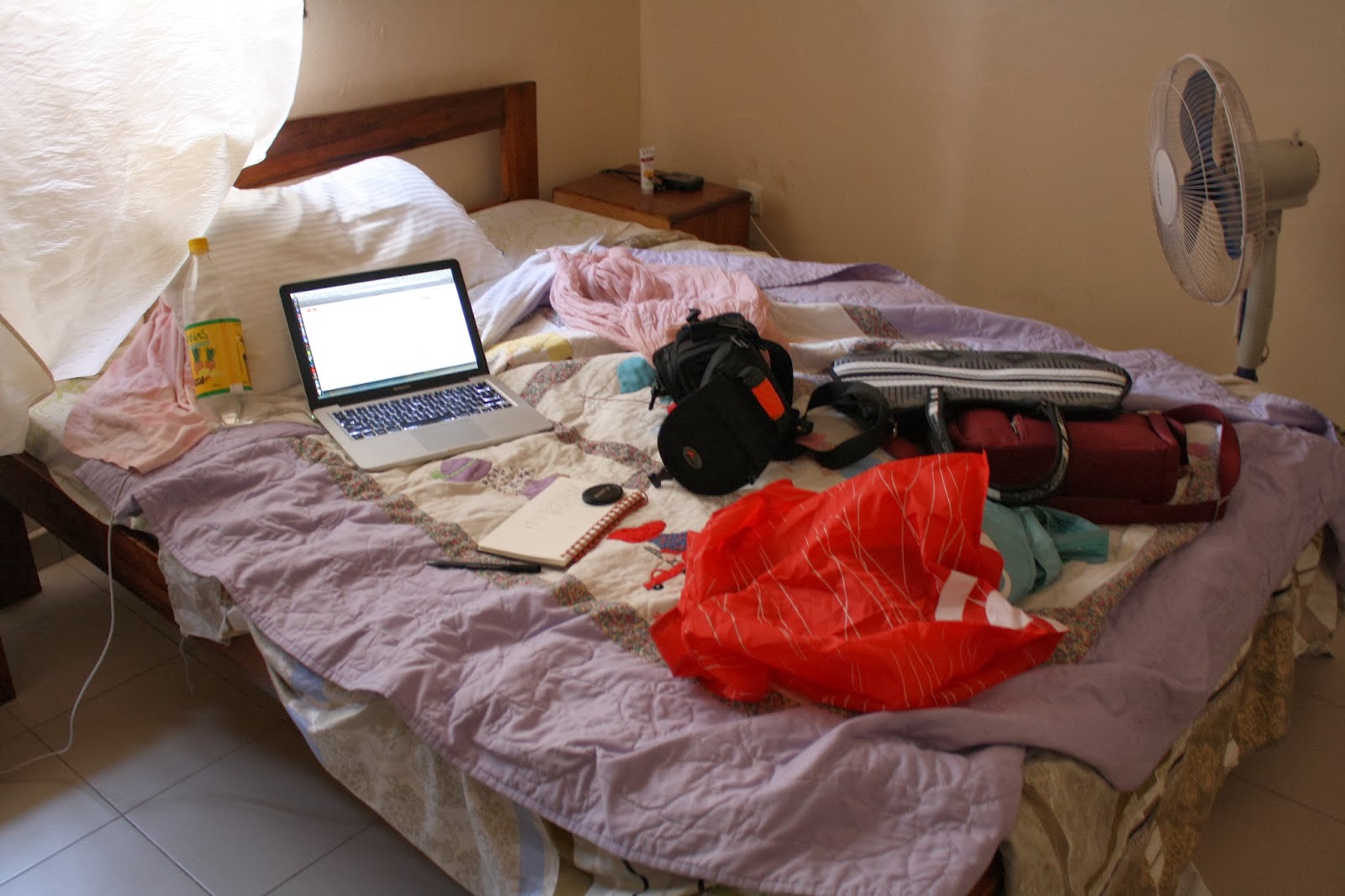
Lucy and I will go out. It will give me a needed hour to get annoyed with a sandal full of sand and grit; to find the fabric shop closed so I can make the trip another day; to ask Lucy to name all the strange vegetables at the stall. We'll return relaxed and happy. Phillipe will be awake and hungry. I will be so happy to stay, to spread out even more on my blogging bed.

Saturday, January 11, 2014

Good health

If the proverbial Martian were to gaze down on this family (or, forget the Martian; let's substitute one of the immense, white-patched crows that glide like wise angels over the whole of Dakar), he would see nothing that makes it stand out—unless it would be the kind of glow that surrounds the families of newborns. There would be papa dandling his son who delights him by learning to make eye contact. Mama's happy: Her breasts remain soft and comfortable because little Philippe has got the hang of nursing and finds that he really likes it. Mami is always smiling to watch the even-tempered development of the family and to know that her contributions have a benign influence. Our gliding crow would pass on, contented with this stop on his beneficent rounds.

He would be right, of course, but he wouldn't see into the details of that well-being; he wouldn't see into the fabric woven of the million little anxieties and doubts that form the actual activity in the household of the neonate. For such a long time (ten days now) everything is a first. Even the most sanguine parents are jellies of nerves and angst, no matter how beautifully they conduct themselves (they do!) and how happy the baby (he is!)

"Is he wet? Why is he awake? Is he sleeping too much? Is he hungry again? Is his poop normal? Why is that red blot on his cheek? Is his umbilical cord infected? Is he too cold? Too hot? Is he normal?"—The latter question underlies all others, despite the fact that his cheeks are rosy, he's filled out to the point of having a little double chin, he lifts his head, he's strong enough now to kick off meddling hands at diaper time, and he examines faces like a master detective—a Bobby Goren or The Mentalist. Parents have to fuss because they are new at this and have to have doubts, the doubts that love and massive protective instincts produce.

This week's medical checkups have been a blessing. On Thursday, both Lucy and Phillipe had their follow-up visits to OB and pediatrician. The doctors practice in the same clinic in the University neighborhood. They are brothers who have added a generalist to the practice and so have a fine arrangement, not to mention one of the most highly-recommended in the city. I enjoyed their waiting room just because of the variety of people who waited there. We were not the only Americans in Western dress. There were even two elderly women, anorexically thin, wearing white go-go boots, skin-tight jeans, and enough gaudy jewelry for a small fashion boutique. There were also Senegalese women, tall, wearing elegant boubous and scarves; a small family of Phillipino descent—a rainbow of ethnicities and, it appeared, income levels. It reminded me of the small town doctor's office I would wait in as a child.

The magazines were good too. Great stacks of French Elle, Men's Health, and Marie Claire; African fashion magazines, Elixir (priced in CFAs) and Miss Ebene (priced in euros). I was particularly interested in the variety of glossy, highly produced African news and business magazines, journals comparable to Time and Fortune. Jeune Afrique had a special financial edition dedicated to assessing the best 200 banks. AM (Afrique Magazine) I found very interesting for its range of topics and its continental inclusivity. It aims to be relevant to all African nations. With the permission of the receptionist I nabbed a fantastic issue from 2010 organized on the theme of 50 years of independence, counting 1960 as the year many countries—certainly Senegal—broke their ties with
colonizers. The varieties of opinions about the uses of those years is fascinating, running from grandly celebratory to bitterly regretful over the depths of lost opportunity of self-governance.

The doctor's office—le Cabinet Medical—was, as I said, old-fashioned by the standards of the group-practice HMOs I've grown accustomed to, where everything is super-white and there are partitions between clients and medical staff at every stage of the visit. American medicine is like that in general: The client is kept in a state of unknowing for as long as possible, ushered around mazes of hallways and encounter rooms by women in baggy outfits printed in juvenile motifs. The doctor appears as if by magic and then, like the protagonist in a drama, he exits the stage, leaving you to grope for an exit that won't lead you into any accidental indiscretion.

The door from the veranda of Cabinet Medical opens onto a long tiled corridor that runs through the building and leads to a tiled staircase with a wrought-iron bannister. At the landing, there is a louvered, open window. The back door stands open too, providing natural light, breezes, and a wonderful sense of ease, so unlike the doctor's office experience I'm used to.

To the right of the entry corridor is the reception room with high, molded plaster ceilings. The receptionist sits at a simple desk that separates her small area from the waiting clients'. She has a telephone, an intramural intercom, and filing "system" consisting of eight white drawers—each approximately 10 x 8," stacked in two tiers upon four metal legs. She has pens to write with, and paper. When a doctor is ready for his or her next appointment, he personally ushers his last patient into the reception area and shakes hands in good-bye. He then smiles to the next patient whom he accompanies himself up the stairs to his consultation room. These rooms are the rooms of a house with windows and tall wooden doors painted blue.

Even I felt better after a trip to the doctors' offices. So did Lucy, whose health was found to be in perfect order, everything healing nicely. So was Phillipe's. He'd gained weight and every question his parents posed had received a reassuring answer to the effect of "perfectly normal." The most alarming part of the doctors' visits was the travel to and from the office: placing the baby in his front carrier, timing his nursing for maximum effectiveness, trying to obtain a taxi manufactured no earlier than 1985, and getting the driver to keep all the windows up against the pollution.

By the time the two separate trips were ended (10:00 appointment for Lucy; 3:00 for Phillipe, each requiring about 2-1/2 hours round-trip), everyone was certified to be in perfect health, yet reduced to emotional putty. I had earlier made a healthy vegetable soup in case of collective lack of will for further efforts. I fed them and saw them all to bed.

Salud! 

Friday, January 10, 2014

All creatures great and small…the Lord God made them all?

I find this a little hard to believe. I understand that adherents to the Jain religion sweep the ground before them in order not to derange let alone kill any little living things, like ants or worms. I think it's a bit extreme, but if you have the time, why not? Still I have to wonder if Cecil Francis Alexander, when he published his hymn lyrics in 1848, was either in a religious rapture or in such an ambition to publish that he never truly paused to consider lice, mites, bedbugs and similar less snuggly fauna.

He hadn't been to Senegal, I'm betting or he, like I, would know that ants and mosquitos are unquestionably damned. Mosquitos are so big here that they are called "tiger mosquitos." It's hard not to take them personally. I'm hard-wired for the sentiment of indignation, so at least they give me something to balance all this maternal pleasure.

Although I am well-bitten—and daily the enterprising, exploratory critters find new continents of my body to conquer—the bites heal pretty quickly and actually aren't as itchy as I'm used to finding mosquito bites at home.

I haven't used insect spray (I don't like it, and no one's suggested it), but there is a definite three-point system of mosquito defense in place. Point one is that the baby sleeps under his mosquito net. This was a gift from his paternal grandparents, the gift I first interpreted as a pretty parasol, and then as the sort of lovely cover one puts over the cheese to keep the flies away on one of those linens-and-champagne picnics suggested by Martha Stewart. It is not something seen in our clime, but a necessity in this, and very effective.

Though there are mosquito nets for grown-ups too, my success with one on another visit here was only partial. I found it quite romantic. But unless the net stays completely tucked under the mattress at all points at all times, it is pointless, and my movements always pulled it out somewhere. Mosquitos will find any door that's open, as I learned.

So the better way, in use now, is a floor fan in each room. I point the fan at my bed, pull up the sheets and a little blanket and let it roar. The wind generated is more than even the ferocious tiger mosquito can deal with, so they can't get me when I'm asleep and can't even pretend to fight back.

The final part of the anti-mosquito campaign is to remember to close the door to the courtyard. Any time the door is open, it's as if the mosquitos have been queuing up at the box office for a Youssou N'Dour concert. The hardworking maid, otherwise irreproachable, has a hard time remembering to close the door when she does laundry, so wash day brings not only sweet-smelling clothes but a new phalanx of mosquitos. When I do the laundry, I am very carful not to let the mosquitos in. The pests get to eat only me, picnic-style, in the sunlight where they can see what they're doing.

Ants are the other damned, pestilential life form endemic here. The natives here are not quite microscopic, but they are extremely small. My first day I mistook a swarm of them for a pile of dirt next to a door jamb.
 There is no way to get rid of the ants. It feels really good to shout and curse at them and to attack them with a soapy rag. It's good for the heart and spirits, and for someone like me, it improves hand-eye coordination. In terms of reducing the infinite population of the pests from hell, these measures are entirely ineffectual.

Sometimes, ants mysteriously don't come when I lie in wait for them. Other times, we have only to drop a crumb on the floor to induce a hungry mob. The photos to the left show how they make haste over the span of a couple of seconds.

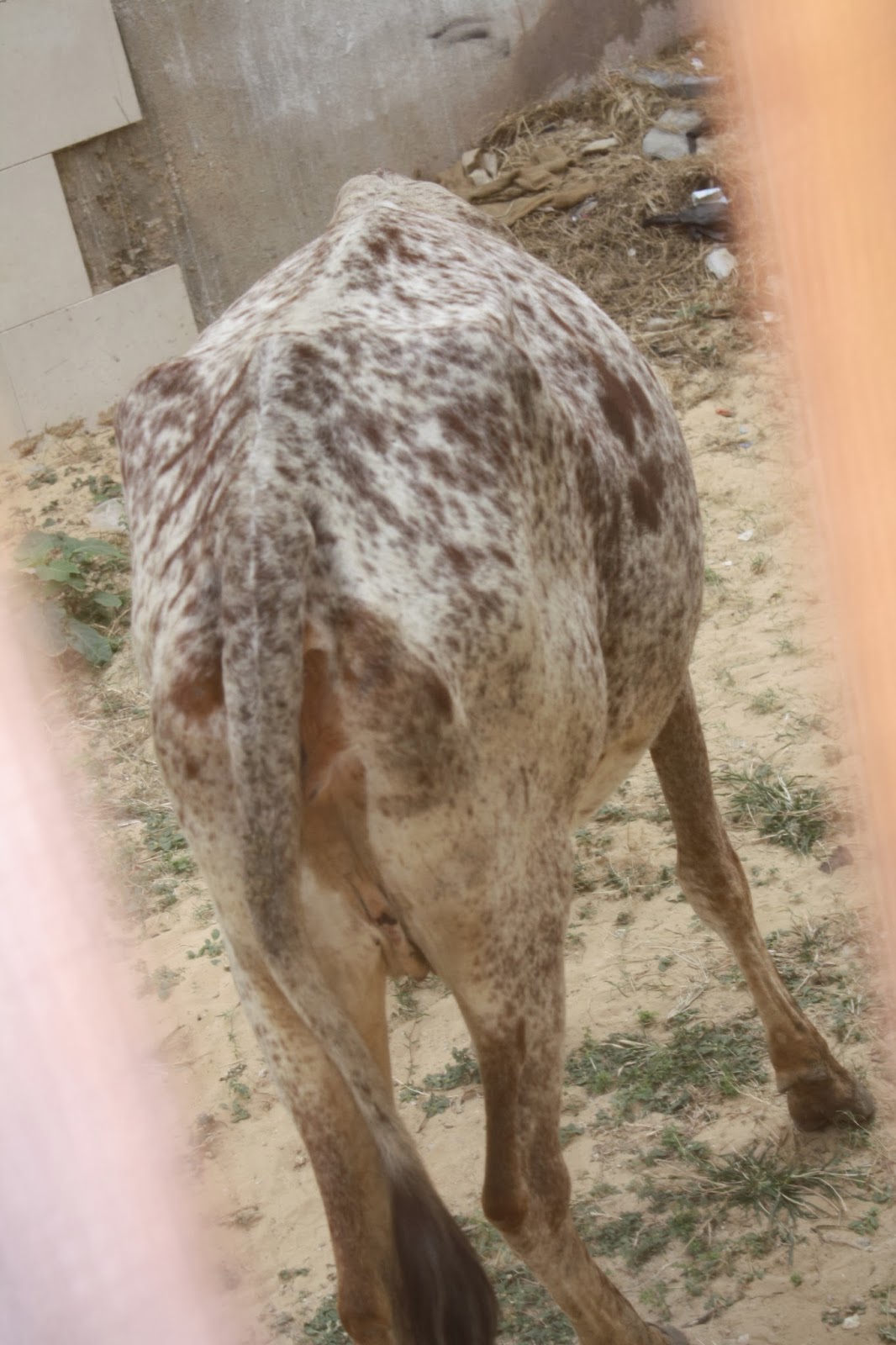
Fortunately, I have not found ants interested in crawling on people. They are so very little and quick in their motions that my nerves would never settle. Fans frighten the mosquitos away. But the very thought of ants in my bed and what measures would be needed to deter them—the whole topic is just too creepy. Happily, I don't have to think about it. The cows moo outside my window, but they just move along on their own, no fans, curses, or soapy rags required.